
Roughly 80% of commercially sold indoor rabbit hutches are too small for the breed they’re marketed for. That’s not a fringe opinion from animal welfare activists — it’s the consistent finding from veterinary behaviorists and rabbit welfare organizations across three continents. The hutch marketed as “perfect for your bunny” at most pet retailers falls below the minimum space standards set by the British Rabbit Council, the House Rabbit Society, and the RSPCA. In some cases by 50–70%.
If you’re buying a hutch based on the product photo, you’re almost certainly buying the wrong size.
Why Hutch Size Has a Direct Impact on Rabbit Health
Rabbits are not passive animals. They evolved to cover up to three miles per day in the wild, and even domesticated breeds retain that need for movement and environmental stimulation. When confined to undersized enclosures, rabbits develop a well-documented cluster of behavioral and physiological problems.
A 2019 study published in Applied Animal Behaviour Science found that rabbits housed in enclosures below recommended minimums showed significantly higher rates of stereotypic behaviors — repetitive, purposeless movements like bar-chewing and circling — compared to rabbits in adequate space. These behaviors are recognized markers of chronic stress, not quirks of personality.
Restricted movement directly contributes to:
- GI stasis — reduced gut motility from inactivity; the leading cause of emergency veterinary visits in rabbits and responsible for the majority of rabbit deaths under five years old
- Spondylosis — spinal degeneration linked to the inability to fully stretch and binky, observed in up to 30% of older rabbits in welfare studies
- Obesity — caloric surplus without sufficient movement, which accelerates joint degeneration and shortens lifespan
- Behavioral aggression — territorial behavior intensified by spatial competition, often misdiagnosed as breed temperament
The Rabbit Welfare Association & Fund (RWAF) in the UK has been campaigning for a decade to establish a minimum floor standard: 3m × 2m × 1m for a pair of rabbits. Most hutches currently sold don’t come close.
The Minimum Size Standards You Should Actually Use
 Foto: Gundula Vogel
Before looking at breed-specific requirements, establish the baseline floor area and height standards from credible organizations.
RWAF and RSPCA Standards (UK)
The RWAF recommends that all rabbit housing — indoor or outdoor — provide a minimum of 6 square meters of combined living and exercise space. This should allow the rabbit to:
- Take at least three consecutive hops in one direction
- Stand fully upright on hind legs without their ears touching the ceiling
- Lie fully stretched in any direction without touching enclosure walls
The RSPCA aligns with this guidance and has explicitly stated that the “small pet hutch” category sold in most pet stores does not meet their welfare standards.
House Rabbit Society Standards (US/AU)
The House Rabbit Society recommends a minimum enclosure of 8 square feet (0.74 sq m) for small breeds, with 24/7 access to at least 24 square feet (2.2 sq m) of exercise space. For medium and large breeds, the enclosure minimum rises to 12 sq ft, with correspondingly larger exercise areas.
What “Exercise Space” Means
Many owners interpret “hutch size” as the total habitat. Best welfare practice requires a separate exercise pen or free-roaming access in addition to the hutch. The hutch is the shelter. The exercise area is where the rabbit actually lives its life.
This distinction matters enormously when sizing your setup. A rabbit confined to its hutch for 20 hours a day and given 4 hours of exercise pen access is not receiving the same welfare benefit as one with continuous, unsupervised access to both spaces — the behavioral difference is measurable within weeks.
Indoor Rabbit Hutch Size by Breed Category
Rabbit breeds span an extraordinary size range — from the 1.1 lb Netherland Dwarf to the 20+ lb Giant Chinchilla. A single size recommendation is meaningless without breed context.
Small Breeds (Under 4 lbs)
Breeds: Netherland Dwarf, Mini Rex, Holland Lop, Polish, Britannia Petite
Despite their small body mass, these breeds are highly active and require more space per pound than larger breeds. Their fast metabolism and curious temperament mean under-stimulation manifests quickly as destructive behavior.
Minimum hutch floor area: 12 sq ft (1.1 sq m) Ceiling height: 24 inches (61 cm) minimum Recommended exercise space: 24 sq ft (2.2 sq m)
The prevailing assumption — that a compact body means a compact space requirement — is wrong in practice. A Netherland Dwarf in a 24-inch hutch is the equivalent of keeping a Border Collie in a bathroom.
Medium Breeds (4–8 lbs)
Breeds: Dutch, Mini Lop, English Angora, Rex, Harlequin, English Spot
This is the most commonly owned category and the one for which the widest range of products is available — unfortunately including many that are under-sized.
Minimum hutch floor area: 18–24 sq ft (1.7–2.2 sq m) Ceiling height: 30 inches (76 cm) minimum Recommended exercise space: 32 sq ft (3 sq m)
For medium breeds, the two-level hutch design offers a practical way to increase total living area without requiring a large floor footprint. A well-designed two-story hutch can achieve adequate space in apartments with limited square footage — provided the ramp or platform transition doesn’t restrict movement for heavier individuals.
Large and Giant Breeds (8+ lbs)
Breeds: Flemish Giant, French Lop, Checkered Giant, Continental Giant, Blanc de Hotot
Large breeds require proportionally larger hutches and are the category most commonly under-served by commercial products. A fully grown Flemish Giant can reach 22 lbs and measure over 30 inches in body length. The physics of adequate space here are non-negotiable.
Minimum hutch floor area: 30–40 sq ft (2.8–3.7 sq m) Ceiling height: 36+ inches (91+ cm) Recommended exercise space: 48+ sq ft (4.5 sq m)
For giant breeds, commercially available hutches are rarely adequate. Custom builds or converting larger furniture — TV cabinets, wardrobes, bookcases with shelving removed — is a well-established practice within the rabbit community and often the most practical solution for these animals.
Indoor Rabbit Hutch Size Comparison Table
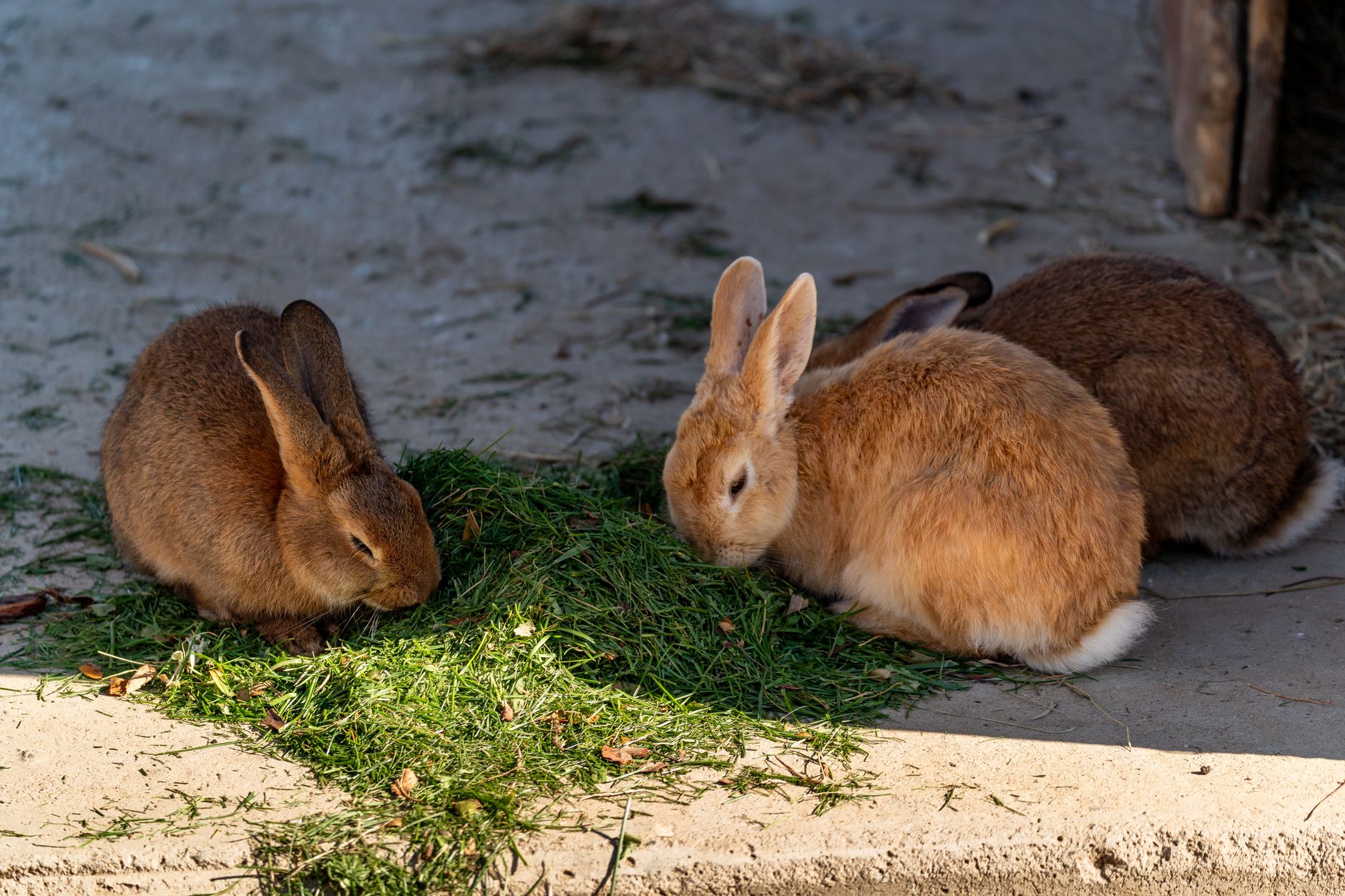 Foto: Gundula Vogel
| Breed Category | Adult Weight | Min. Hutch Floor Area | Min. Ceiling Height | Min. Exercise Space | Two-Level Viable? |
|---|---|---|---|---|---|
| Small (e.g., Netherland Dwarf) | Under 4 lbs | 12 sq ft | 24 in / 61 cm | 24 sq ft | Yes |
| Small-Medium (e.g., Mini Lop) | 4–6 lbs | 18 sq ft | 28 in / 71 cm | 28 sq ft | Yes |
| Medium (e.g., Dutch, Rex) | 6–8 lbs | 24 sq ft | 30 in / 76 cm | 32 sq ft | Yes |
| Large (e.g., French Lop) | 8–12 lbs | 30 sq ft | 34 in / 86 cm | 40 sq ft | Partial |
| Giant (e.g., Flemish Giant) | 12+ lbs | 40 sq ft | 36+ in / 91+ cm | 48+ sq ft | Rarely |
Sources: RWAF minimum standards, House Rabbit Society guidelines, RSPCA welfare benchmarks
These are minimums, not ideals. The RWAF and most rabbit veterinarians recommend exceeding these figures by at least 25% where space allows. A rabbit that has more space than the minimum will consistently display better behavioral and physical health outcomes.
Common Sizing Mistakes Indoor Rabbit Owners Make
Buying Based on Current Size, Not Adult Size
Rabbits sold at pet stores are typically 8–12 weeks old, weighing a fraction of their adult mass. A French Lop kit that weighs 2 lbs at purchase will reach 12–14 lbs at maturity. The hutch that seemed spacious at adoption will be critically undersized within six months.
Always size for adult weight, which you can find via the breed standard from the American Rabbit Breeders Association (ARBA) or the British Rabbit Council (BRC). Breed standards list both minimum and maximum adult weight ranges — use the upper end to avoid undersizing mid-growth.
Ignoring Ceiling Height
Floor area gets most of the attention, but ceiling height is equally important. Rabbits stand on their hind legs constantly — to survey their environment, to stretch, during play, and when curious. An inability to perform this natural behavior is a documented welfare concern, not a minor inconvenience.
The RWAF minimum of 1 meter (approximately 39 inches) for combined housing is specifically designed to allow full upright posture. Most standard hutches fall 6–10 inches below this threshold. For lop breeds, which carry more body mass in the hindquarters, adequate ceiling height is even more critical for comfortable upright posture.
Conflating Hutch Size with Total Habitat
A 12 sq ft hutch with 12-hour lockdown is not equivalent to a 12 sq ft hutch with 24/7 access to a 32 sq ft exercise pen. The latter setup delivers dramatically better welfare outcomes. When evaluating hutch size, always consider:
- Access frequency: How many hours per day is the rabbit confined?
- Exercise pen integration: Is the hutch permanently attached to a run, or does access require human intervention?
- Enrichment density: Tunnels, platforms, and foraging toys can partially compensate for modest floor area if access to larger spaces is consistent
Indoor Hutch Design Principles That Affect Effective Space
 Foto: Kirandeep Singh Walia
Physical dimensions are necessary but not sufficient. A 24 sq ft hutch configured poorly can function worse than an 18 sq ft hutch designed well.
Floor surface: Wire-bottom cages cause pododermatitis — pressure sores on the hock joints that progress to deep tissue infection if untreated. Solid floors with washable fleece mats or paper-based bedding eliminate this risk entirely. Wire flooring is an indoor welfare hazard regardless of hutch dimensions.
Ventilation vs. draft: Indoor hutches need adequate airflow to prevent ammonia buildup from urine — concentrations above 25 ppm cause measurable respiratory damage — but rabbits are highly susceptible to respiratory illness from cold drafts. Position hutches away from air conditioning vents, exterior walls, and windows with frequent temperature fluctuation.
Visual territory: Rabbits feel more secure with at least one enclosed hide box where they can retreat from stimulation. Research on prey animal behavior consistently shows that access to concealed retreats lowers cortisol markers even when ambient space is otherwise adequate. A hide box reduces chronic low-level stress in any enclosure size.
Multi-rabbit configurations: If housing two rabbits, add 50% to all minimum floor area figures. Two bonded rabbits will use shared space more efficiently than two housed separately, but the spatial budget still increases substantially.
The Verdict: What Size Hutch Do You Actually Need?
The honest answer for most indoor rabbit owners: larger than what’s stocked at your local pet retailer.
For small breeds like a Netherland Dwarf or Mini Rex, start your search at 12 sq ft minimum floor area, with a permanent exercise pen of at least 24 sq ft. For medium breeds — Dutch, Rex, Mini Lop — you’re looking at 18–24 sq ft hutch area and 30+ sq ft for exercise.
For large and giant breeds, commercial options will disappoint. Plan for custom builds, converted furniture, or x-pen configurations that achieve the 30–40 sq ft floor area these animals genuinely require.
The industry is catching up slowly. Brands like Kavee, Midwest Homes for Pets, and Living World have introduced larger C&C-style modular systems that approach welfare-compliant dimensions — particularly for small and medium breeds. But the default assumption when browsing hutches — that the product is sized appropriately for the animal on the label — is statistically wrong the majority of the time.
Size to the breed, not the marketing copy, and your rabbit will live measurably better for it.
Ready to find the right hutch? Use the comparison table above as your baseline and cross-reference with the adult weight for your specific breed via the ARBA or BRC breed standards. If you’re unsure which breed best fits your living space and lifestyle, a rabbit-specialist rescue or a rabbit-savvy veterinarian is far more reliable than a pet store recommendation.
Frequently Asked Questions
Why does hutch size have a direct impact on rabbit health?
Rabbits evolved to cover up to three miles per day in the wild and need constant movement and environmental stimulation. Undersized hutches prevent natural movement, causing chronic stress and serious health problems including GI stasis, spondylosis, obesity, and behavioral aggression.
What are stereotypic behaviors and why do they indicate a problem?
Stereotypic behaviors are repetitive, purposeless movements like bar-chewing and circling that are recognized markers of chronic stress. Research shows rabbits in undersized enclosures display significantly higher rates of these behaviors compared to rabbits with adequate space.
What health problems result from undersized rabbit hutches?
Restricted movement leads to GI stasis (the leading cause of emergency vet visits), spondylosis (spinal degeneration affecting up to 30% of older rabbits), obesity that accelerates joint problems, and territorial aggression often misdiagnosed as breed temperament.


