
What are the best dog grooming clippers for home grooming? Millions of pet owners search that question every year, and the short answer is: it depends on your dog’s coat, but for most home groomers, the Wahl KM10 (corded) and the Andis ProClip AGC2 come up again and again. If you want something more budget-friendly for a light-coated dog, the Oster A5 Turbo still holds its own after decades on the market.
What it depends on is worth unpacking.
What Makes a Set of Clippers Actually Good for Home Grooming?
Professional groomers talk about this constantly: most consumer clippers sold at big-box pet stores are underpowered for anything thicker than a golden retriever puppy coat. The motor heats up fast, blades dull quickly, and the vibration spooks dogs who might otherwise tolerate grooming well.
The clippers worth buying share a few traits:
- Strong rotary or electromagnetic motor — handles thick, matted, or double coats without bogging down
- Replaceable blade system — you can swap #7, #10, #30, and other standard blades instead of replacing the whole unit
- Low vibration and noise — especially important for nervous dogs
- Runs cool — heat causes hesitation, flinching, and burns if you’re not careful
The brands that consistently hit these marks at home-grooming price points are Wahl, Andis, Oster, and Heiniger. Everything else is a distant second for consistent at-home use.
Rotary vs. Electromagnetic Motors — Does It Actually Matter?
Yes, more than most people realize.
Rotary motors (found in Wahl KM10, Andis Pulse ZR II) run at variable speeds, are quieter, and handle heavy coats without stalling. They’re the preferred choice for thick double coats like Huskies, Chow Chows, and Bernese Mountain Dogs.
Electromagnetic motors (Andis AGC2, Oster A5) run at fixed high speeds and produce more heat over time, but they’re extremely powerful for their size and hold up well in home use. They’re often preferred for fine or medium coats where you want clean, fast cuts.
If you’re grooming a large breed with a heavy coat once a month, go rotary. If you’re touching up a poodle mix every few weeks, electromagnetic is fine.
Which Clippers Are Best for Thick, Double-Coated Breeds?
 Foto: Tima Miroshnichenko
Double-coated dogs — German Shepherds, Samoyeds, Malamutes, Huskies — are genuinely hard on clippers. The coat is dense, sometimes matted near the skin, and most home-grade clippers simply can’t push through it consistently.
For these breeds:
| Clipper | Motor Type | Best For | Price Range |
|---|---|---|---|
| Wahl KM10 | 2-speed rotary | Double coats, large breeds | $280–$330 |
| Andis ProClip AGC2 | 2-speed electromagnetic | Medium to thick coats | $160–$200 |
| Oster A5 Turbo 2-Speed | 2-speed electromagnetic | Heavy use, all coat types | $150–$190 |
| Andis Pulse ZR II | Variable speed rotary | Thick coats, sensitive dogs | $300–$370 |
| Wahl Bravura Lithium | Rotary, cordless | Light to medium coats | $100–$130 |
| Andis EasyClip Multi-Style | Single speed | Fine coats, touchups | $40–$60 |
The Wahl KM10 is the benchmark. It runs at either 2,700 or 3,400 strokes per minute, it costs more than you’d expect — but it will outlast three cheaper clippers and never stall on a dense coat. It’s the clipper professional groomers reach for at home too.
If the KM10 price is hard to justify, the Andis ProClip AGC2 gets you 85% of the way there at a meaningfully lower entry point. It runs hotter after extended sessions, so take breaks during grooming jobs that exceed 30 minutes.
What About Blades — Are Included Blades Any Good?
Most professional clippers ship with a #10 blade, which leaves about 1/16 inch of coat — the standard for body cuts on most breeds. The included blade is usually decent quality and will carry you through the first few months.
After that, you’ll want a few extras:
- #7 skip tooth — longer cut, good for body work on fluffy breeds
- #30 — short, tight cuts around paws and face
- #40 — surgical short, mainly for paw pads and sanitary areas
Buy blades from the same brand as your clippers. Wahl blades fit Wahl, Andis blades fit Andis — they’re not universal, despite what some third-party listings claim.
What’s the Best Cordless Clipper for Home Grooming?
Cordless clippers have gotten genuinely good over the last five years. The concern used to be that battery-powered meant underpowered — that’s no longer true at the mid-range and above.
The Andis Pulse ZR II leads the category. It runs on a lithium-ion battery rated for 3+ hours per charge, uses the standard AGC blade system, and has variable speed control. Groomers who travel or work at client homes rely on it for exactly those reasons.
For something less expensive, the Wahl Bravura Lithium handles smaller dogs or touch-up work without drama. It won’t power through a Newfoundland coat, but for a poodle, bichon, or shih tzu, it’s more than adequate.
Things to check before buying cordless:
- Battery life stated in hours, not “sessions” (marketing language)
- Whether replacement batteries are sold separately
- Blade compatibility — proprietary or standard A5-style
- Charge time relative to run time (aim for better than a 1:1 ratio)
Avoid any cordless clipper under $60 claiming to handle “all breeds.” They overheat, the batteries degrade within a year, and the motors lack the torque for anything beyond the lightest coats.
How Do You Keep Your Dog Calm While Grooming at Home?
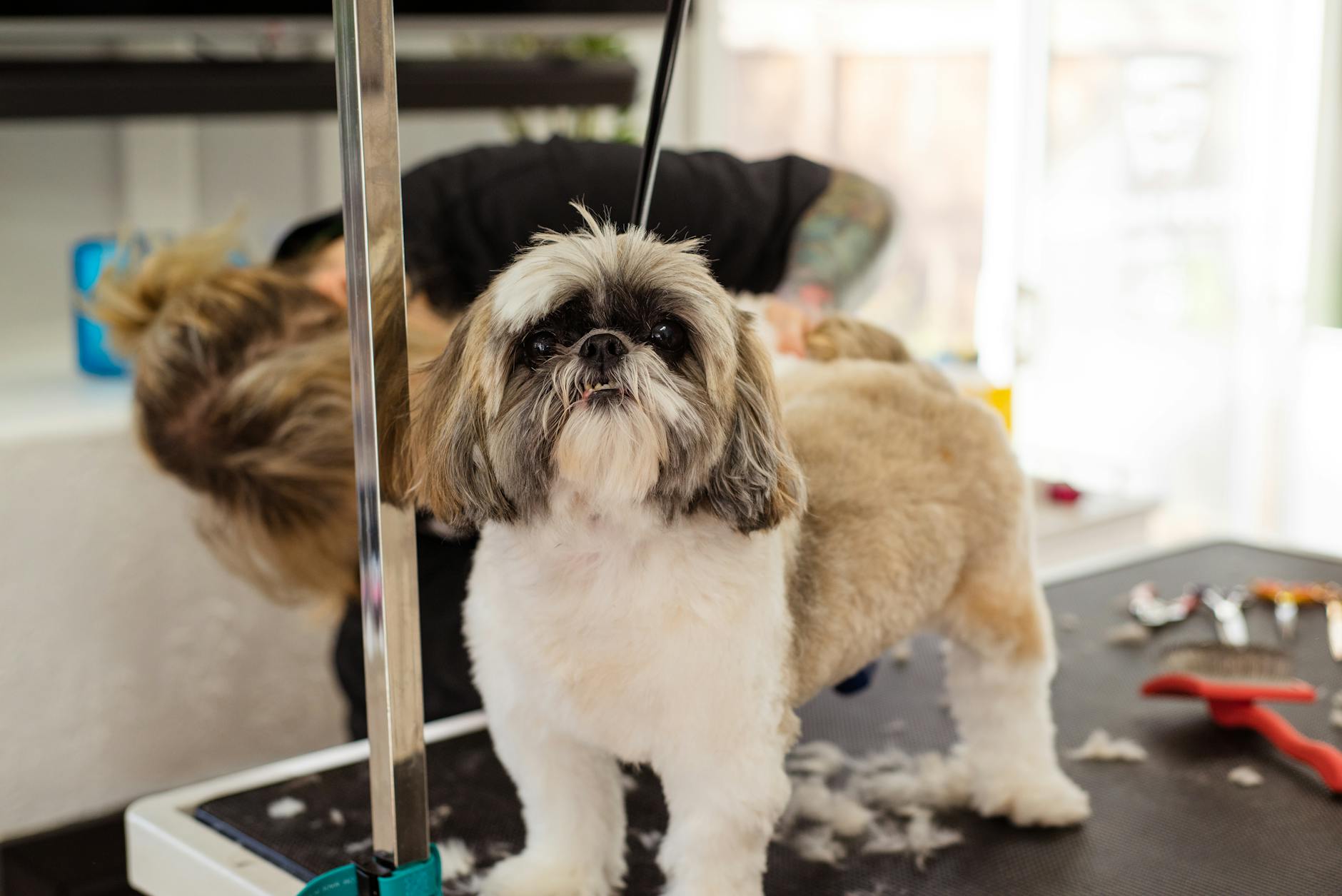 Foto: Goochie Poochie Grooming
The clippers are only part of the equation. The other part is your dog’s cooperation — and that’s something you build over time, not something you buy.
Dogs that panic at home grooming are usually reacting to three things: sound, vibration, and past negative experiences. The goal is to desensitize gradually before you ever touch coat.
Desensitization Steps That Actually Work
Week 1: Turn on the clippers near your dog without touching them. Let your dog sniff the clippers while off. Reward calmly with treats.
Week 2: Touch the (off) clippers to different parts of your dog’s body — back, sides, legs. Let them feel the weight and temperature. Reward throughout.
Week 3: Turn on the clippers nearby while your dog eats a high-value treat like chicken or freeze-dried liver. Keep sessions under 3 minutes.
Week 4: Touch the running clippers to your dog’s side — back and flank first, away from face and paws. Stop immediately if they freeze or try to move away. End on a positive.
This process is slow by design. Dogs introduced this way tend to walk into the grooming area on their own rather than hide under the bed when clippers come out.
For dogs already reactive to grooming, consider a grooming loop and non-slip mat to keep them safely stationary. If anxiety is significant, talk to your vet before assuming the dog will simply habituate — some dogs benefit from a short-term anti-anxiety protocol during the introduction phase.
Does Clipper Noise Level Matter That Much?
For sensitive dogs, yes — significantly. The Wahl KM10 runs noticeably quieter than most cheaper clippers despite being more powerful, largely because of how the rotary motor is engineered. The Andis AGC2 produces a characteristic high-pitched hum that some dogs find stressful.
If your dog is noise-sensitive, prioritize rotary motors and filter user reviews specifically for comments about noise before buying.
Are the Same Clippers Good for Cats Too?
Cats are a different challenge — not because of coat type, but because most cats have a much lower tolerance for restraint than dogs do. Cat grooming at home is generally harder to execute safely, not technically more complex.
The same clippers work if the cat tolerates the process. A few specifics:
- Use a #10 blade for basic coat maintenance on long-haired cats like Maine Coons and Persians
- Cats have thinner, more elastic skin than dogs — move slowly, keep the blade flat against the skin, and never rush through an uncomfortable area
- For matted coats, a #7 skip tooth blade pulls less than a standard blade and reduces the risk of catching the skin beneath a mat
If your cat has significant matting — particularly in the armpits, groin, or belly — don’t try to power through it with clippers. Mats trap skin and pulling them is painful. A groomer experienced with cats, or your vet, is the right call in those cases.
For routine maintenance — belly, armpits, and sanitary areas — the Wahl Bravura is a popular choice for cat owners specifically because of its quieter rotary motor and compact body. At roughly 5.5 ounces, it’s much easier to maneuver around a cat’s joints and folds than a full-size unit.
How Do You Maintain Clippers So They Last?
 Foto: Gustavo Fring
This is where most home groomers lose money. A $250 set of clippers that’s never cleaned or oiled will perform worse within a year than an $80 set maintained consistently.
After every grooming session:
- Remove the blade and brush out all hair from the blade and blade port with a stiff brush
- Apply 2–3 drops of clipper oil to the top and sides of the blade while running for 5–10 seconds
- Wipe off excess oil with a cloth
Monthly:
- Dip the running blade in blade wash or Andis Cool Care spray for 3–5 seconds to clean internal surfaces
- Check blade tension — most professional blades have a small adjustment screw
- Inspect the drive gear for wear, visible inside the blade port
Signs your blade needs replacing:
- Pulling or snagging even on freshly bathed, dry coat
- Visible dullness or nicks on the cutting edge
- Inconsistent cut length across the width of the blade
Professional blade sharpening typically runs $5–8 per blade and extends blade life significantly. For blades you use regularly, sharpening twice a year makes more economic sense than buying replacements every few months.
Store your clippers in their case, not sitting out on a shelf. The drive parts are precision-machined — they don’t need extra dust and hair working into the mechanism between sessions.
The Bottom Line
For most home groomers willing to invest in a proper setup, the Wahl KM10 with a #10 and #7 blade is as close to a universal solution as exists among the best dog grooming clippers for home grooming — it handles everything from labradors to doodles, won’t stall halfway through a heavy coat, and runs for years with basic maintenance.
If the price is the obstacle, the Andis ProClip AGC2 or the Oster A5 Turbo deliver professional-grade results at a lower entry cost, and both use widely available A5-style blades that are easy to find.
For small dogs and cats, the Wahl Bravura Lithium is quieter, lighter, and more maneuverable — the right tool for close work around the face, paws, and belly.
Whatever you buy, pair it with a quality blade, keep it oiled after every session, and take the time to introduce it to your dog properly. The right clippers in the hands of a patient owner save most households $400–$600 per year in grooming fees — and once your dog is comfortable, the sessions become routine rather than something to dread.
Frequently Asked Questions
What makes a set of clippers actually good for home grooming?
Good clippers need a strong rotary or electromagnetic motor, replaceable blade system, low vibration and noise, and must run cool to avoid hesitation or burns.
What’s the difference between rotary and electromagnetic motors?
Rotary motors run at variable speeds, are quieter, and handle heavy coats best. Electromagnetic motors run at fixed high speeds, produce more heat, but deliver extreme power for their size.
Which dog clippers are best for home grooming on a budget?
The Oster A5 Turbo is the best budget option and has held its own for decades. For most home groomers, the Wahl KM10 and Andis ProClip AGC2 are the most recommended choices.


