
Roughly 80% of ball python health problems reported in veterinary herpetology practices trace back to a single cause: incorrect enclosure conditions — not diet, not genetics, not handling frequency. That statistic, cited repeatedly by exotic animal veterinarians and reptile rescues alike, cuts against the popular narrative that ball pythons are forgiving starter snakes. They are tolerant. They are not indestructible.
The distinction matters because “tolerant” means a ball python will survive a suboptimal setup for months before showing symptoms. By the time a keeper notices lethargy, incomplete sheds, or respiratory wheezing, the animal has been compensating in silence for far longer than most owners realize.
Getting the enclosure right from day one isn’t obsessive — it’s the single highest-leverage action a new keeper can take.
Why Most Beginner Enclosures Fail
The reptile hobby has an entry-level problem. Big-box pet stores still sell 10-gallon glass tanks as “starter kits” for ball pythons, despite decades of evidence that enclosures under 4 square feet of floor space produce chronic stress in adult specimens. Stressed ball pythons refuse food. Keepers interpret this as a feeding problem. The snake gets moved to a smaller “isolation” container. The stress compounds.
Ball pythons (Python regius) are native to sub-Saharan West and Central Africa, where they spend the majority of their time inside termite mounds and mammal burrows — enclosed, humid, thermally stable microhabitats. Their stress response is calibrated to open, exposed spaces as a threat signal. An under-sized enclosure with glass walls and ambient light penetrating from all sides mimics the experience of being in the open, not inside a burrow.
Research published in Applied Animal Behaviour Science on captive snake welfare found that snakes provided with appropriately sized, visually opaque hides showed significantly lower corticosterone levels (a key stress hormone) than those in enclosures without adequate retreat sites. The physiology is not ambiguous.
The Three Failure Points
Almost every problematic beginner setup breaks down in one or more of these three areas:
- Thermal gradient collapse — a single heat source with no verified cool side, resulting in the snake having no way to thermoregulate
- Humidity inconsistency — levels that spike and crash with ambient room conditions rather than being mechanically maintained
- Inadequate hides — one hide, wrong size, wrong placement, or wrong material
Address all three, and the vast majority of ball python health and feeding issues resolve or never materialize.
Enclosure Size: The Numbers That Actually Matter
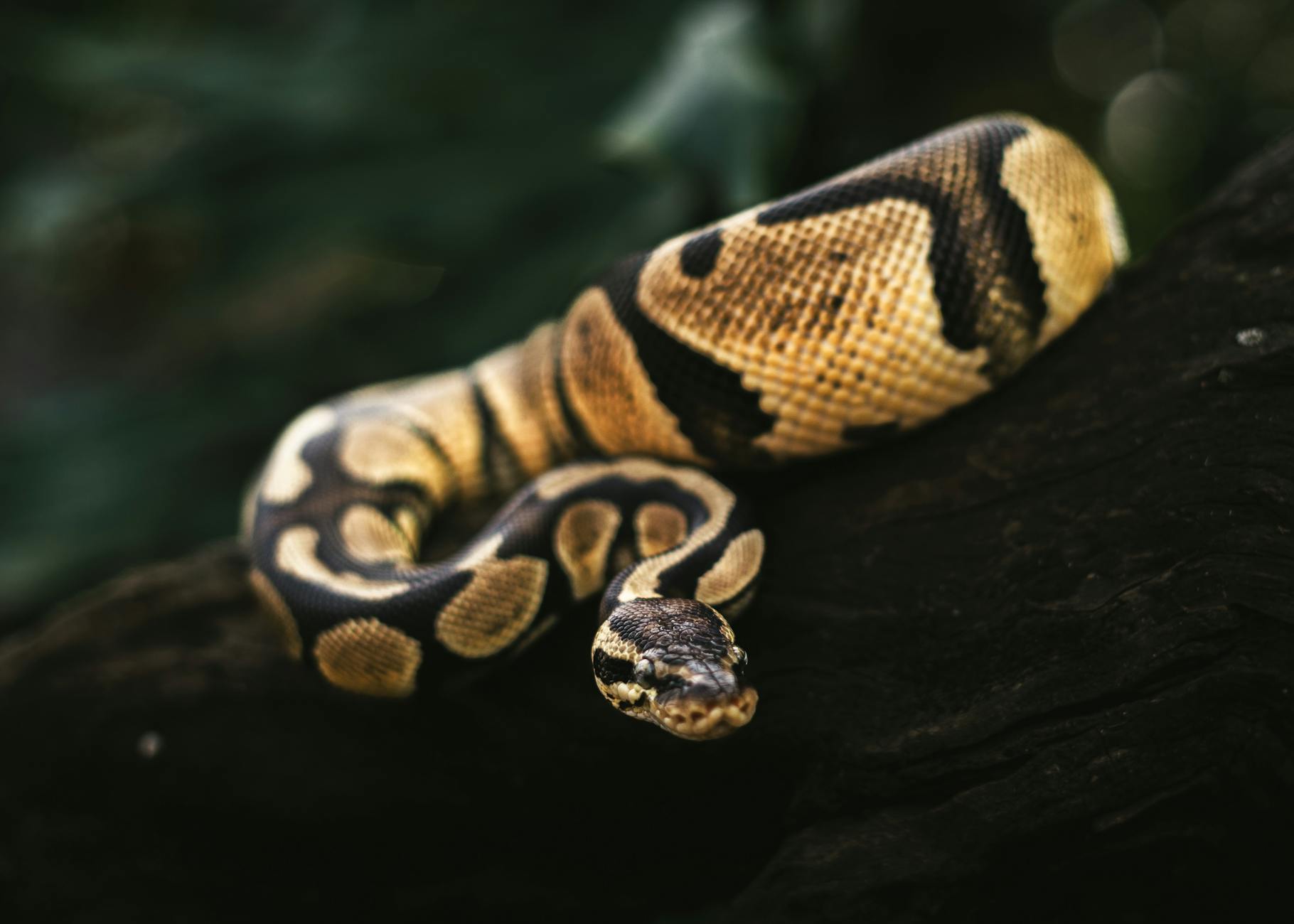 Foto: Giulia Botan
Hatchling ball pythons emerge from eggs averaging 10–17 inches in length. Adults reach 3–5 feet, with females consistently larger than males. A keeper who starts with a hatchling-appropriate setup and upgrades twice will spend more money and create more disruption than one who starts with an adult-ready enclosure from the beginning.
The minimum recommended enclosure dimensions for an adult ball python are 4 feet long × 2 feet wide × 2 feet tall (approximately 120L × 60W × 60H cm). This provides 8 square feet of floor space and meets BIAZA (British and Irish Association of Zoos and Aquaria) welfare guidelines, which require a minimum floor area of at least the snake’s length squared.
For hatchlings and juveniles under 18 inches, a 24 × 18 × 12-inch enclosure prevents the “too large” stress effect that some young snakes exhibit in oversized spaces when hides aren’t positioned correctly.
Enclosure Types: Plastic, PVC, and Glass
Three materials dominate the market. Each has meaningful trade-offs beyond aesthetics.
Front-opening PVC and HDPE enclosures from manufacturers like Zen Habitats, Reptile Sciences, or Vision Cages are the professional standard. PVC retains heat significantly better than glass — studies on thermal regulation in captive reptile housing show that PVC enclosures require up to 40% less wattage to maintain target temperatures than equivalent glass setups. They also hold humidity better, reducing the labor required to maintain the 60–80% RH range ball pythons need.
Glass terrariums (such as Exo Terra or Zoo Med Naturalistic Terrariums) are widely available and visually appealing, but require additional work to manage heat loss and humidity. Foil backing on three sides, cork backgrounds, and foam tape on screen lids are commonly used workarounds. They’re functional with modification, but they’re not the path of least resistance.
Plastic tubs (Sterilite, IRIS, or purpose-built rack systems) are the choice of serious breeders managing 50+ animals. Heat retention is excellent, humidity holds well with minimal substrate, and cost per animal is low. The trade-off is aesthetics and limited visibility for observational enrichment.
Temperature and Humidity: The Engineering Problem
Ball pythons require a thermal gradient — not a single temperature, but a range across the enclosure that allows behavioral thermoregulation. The snake moves between zones to regulate its metabolism. Without a gradient, it cannot do this, and physiological processes including digestion, immune function, and shed cycling are compromised.
Target Temperature Ranges
| Zone | Target (°F) | Target (°C) | Purpose |
|---|---|---|---|
| Warm hide (belly heat) | 88–92°F | 31–33°C | Digestion, metabolism |
| Warm side ambient | 82–85°F | 28–29°C | General warm-side activity |
| Cool side ambient | 76–80°F | 24–27°C | Thermoregulation retreat |
| Nighttime drop | 72–75°F | 22–24°C | Acceptable; natural light cycle |
Belly heat is non-negotiable. Ball pythons are poikilothermic — they cannot generate their own body heat. Digestion requires the warm-side belly temperature to reach at least 88°F. A snake fed at insufficient belly temperatures will regurgitate, and repeated regurgitation causes esophageal damage requiring veterinary intervention.
A thermostat is not optional equipment. Heat mats, radiant heat panels, and ceramic heat emitters all require a proportional thermostat (not a simple on/off rheostat) to hold stable temperatures. Herpetological Lighting and Heating guidelines from the BSAVA (British Small Animal Veterinary Association) explicitly state that unregulated heat sources represent a primary welfare risk in reptile keeping.
Humidity Management
The 60–80% relative humidity range replicates the sub-Saharan forest floor and savanna microhabitats ball pythons occupy. Below 50% RH consistently, incomplete sheds (dysecdysis) become likely — retained eye caps are a veterinary emergency.
Practical humidity maintenance options:
- Deep substrate (4–6 inches) of cypress mulch, coconut fiber, or bioactive mix retains moisture and releases it slowly, buffering against spikes and crashes
- Humid hide on the cool side filled with damp sphagnum moss provides a dedicated high-humidity zone for pre-shed periods
- Avoid screen-top enclosures unless significantly modified — screen lids can drop enclosure humidity to ambient room levels (often 30–40%) in minutes
A digital hygrometer with a probe placed mid-enclosure gives accurate ambient readings. Pulse-dose misters on timers are useful in dry climates but not essential in most environments.
Equipment Comparison: Complete Beginner Setups
 Foto: Tyler Mascola
| Setup | Enclosure | Heating | Substrate | Est. Cost (USD) | Humidity Control | Recommended For |
|---|---|---|---|---|---|---|
| Budget PVC | Zen Habitats 4×2×2 | Heat mat + Inkbird thermostat | Coconut fiber | $250–$320 | Good | Most beginners |
| Glass + Mods | Exo Terra 36×18×24 | UTH + CHE + dual thermostats | Cypress mulch | $200–$280 | Moderate (needs mods) | Urban apartments, display priority |
| Tub System | 41-qt IRIS or similar | Heat tape + rack thermostat | Paper towel / coconut fiber | $60–$100 | Excellent | Breeders, multiple animals |
| Premium PVC | Vision Cage 431 or BP Cages | Radiant heat panel + Herpstat | Bioactive mix | $500–$800 | Excellent | Long-term keepers wanting minimal maintenance |
| Glass Naturalistic | Zoo Med 48×24×24 | CHE + basking spot + dual thermostats | Bioactive/topsoil blend | $350–$500 | Good (with mods) | Display-focused, experienced keepers |
The Zen Habitats 4×2×2 PVC enclosure with an Inkbird IBS-TH2 or Herpstat 2 thermostat and an iPower or Vivosun heat mat represents the current best-value setup for the best beginner ball python tank setup. It requires no significant modification, holds humidity without a mister in most climates, and scales to adult animals without an upgrade.
Substrate, Hides, and Enrichment
Substrate serves two functions: humidity buffering and burrowing enrichment. Ball pythons will burrow and reorganize loose substrate — this is normal exploratory behavior, not stress. A depth of 4–6 inches of loose substrate allows this while retaining the moisture gradient needed for consistent humidity.
Top substrate choices for beginners:
- Coconut fiber (coir) — widely available, retains moisture well, affordable, easy to clean
- Cypress mulch — natural antimicrobial properties, excellent humidity retention, aesthetic appeal
- Topsoil/sand/orchid bark bioactive blend — optimal long-term but requires more initial investment and live microfauna to process waste
Avoid: pine or cedar shavings (aromatic oils are toxic to reptiles), pure sand (desiccates the environment), reptile carpet (harbors bacteria, causes abrasion injuries).
A water dish large enough for full submersion belongs on the cool side of the enclosure. During pre-shed periods, ball pythons soak voluntarily to aid ecdysis. A 6–8 inch ceramic or stainless steel bowl — heavy enough to resist tipping — is sufficient for most adults. Change the water every 2–3 days regardless of visible contamination; bacterial film develops quickly at the temperatures required in a well-heated enclosure.
Hide Selection
Two hides minimum — one on the warm side, one on the cool side. The hide must be snug to the animal’s body. A ball python inside a hide that’s too large will not feel secure. The fit is more specific than most guides acknowledge: the interior should be roughly 1.5× the snake’s girth at its widest point, not proportional to its length. A correctly sized hide should have the roof making light contact with the snake’s coiled body — the behavioral indicator is a fully enclosed posture with no gap at the entry.
A single hide centered in the enclosure is the most common beginner error. This forces the snake to choose between security and thermoregulation. It cannot optimize both simultaneously, and chronic low-level stress results.
Commercial options like Exo Terra Snake Cave or Zoo Med ReptiShelter work well. DIY cork bark rounds, half-logs, and inverted plastic containers are equally effective. Material matters less than fit and placement.
Final Verdict: What a Correct Setup Actually Costs
 Foto: XT7 Core
A properly configured beginner ball python enclosure runs $200–$350 in the US, $180–$320 in the UK, and AUD$300–$500 in Australia, depending on sourcing. This is roughly 2–3x what a big-box store starter kit costs — and approximately 10–20x less than the veterinary bill for an impaction, respiratory infection, or retained shed requiring surgical intervention.
New animals need 2–3 weeks without feeding attempts or unnecessary handling after the initial setup. A freshly acquired ball python is processing the stress of transport, new smells, and unfamiliar temperature gradients simultaneously. Offering a meal before the snake has established a consistent hide routine risks regurgitation — and in most of those cases, the setup is the problem, not the animal. Let the enclosure stabilize the snake before introducing feeding.
The variables that matter most, ranked by impact:
- Thermostat-regulated belly heat at 88–92°F
- Dual hides, correctly sized, warm and cool sides
- Ambient humidity maintained at 60–80% RH
- Enclosure floor space of at least 8 square feet for adults
- Loose, moisture-retaining substrate at 4–6 inch depth
Everything else — UVB lighting (beneficial but not critical), bioactive builds, naturalistic decor — is optimization layered on top of this foundation.
If you’re building a setup now, the Reptile Apartment community on Reddit’s r/ballpython and the Ball Python Husbandry Resources document compiled by the community’s moderators are the most consistently accurate free resources available. Both are maintained by experienced keepers and updated as husbandry understanding evolves.
Get the thermal gradient and the hides right. Everything else follows.
Frequently Asked Questions
Why do most beginner ball python enclosures fail?
Beginner enclosures are too small and lack proper hides. Ball pythons need at least 4 square feet of floor space and enclosed hides to mimic their natural burrow habitats. Undersized tanks create chronic stress that leads to feeding refusal and health problems.
How much space does a ball python actually need?
Adult ball pythons require a minimum of 4 square feet of floor space. Enclosures under this size, like the commonly sold 10-gallon starter tanks, cause chronic stress despite the snake surviving for months before visible symptoms appear.
Why are visually opaque hides important for ball pythons?
Ball pythons evolved in enclosed termite mounds and mammal burrows in Africa. They interpret open, exposed spaces as a threat. Appropriately sized enclosures with opaque hides significantly lower their stress hormone (corticosterone) levels compared to tanks without visual security.


